Design for Manufacturing: practical guide to a manufacturable design
A good product design must not only be functional and attractive but also efficiently manufacturable. Design for Manufacturing brings design, engineering, material choice and production together early. This article explains how DFM helps limit costs, delays and production risks and how you progress from concept to a reliable, manufacturable product.
In brief
- Design for Manufacturing means taking manufacturing techniques, material use, costs and production volumes into account already during the design phase.
- By testing manufacturability early, you avoid costly changes to tooling, extra test cycles and delays during market introduction.
- Design for Assembly additionally focuses on reducing parts, assembly steps and potential assembly errors.
- By organising design, engineering, prototyping and production as a single process, a reliable and production-ready design is achieved more quickly.
","Slug / URL-pad":"design-for-manufacturing-summary"}
Anyone searching for a definition of design for manufacturing will usually encounter English-language or academic descriptions that offer little practical guidance for day-to-day work. For an SME developing a new product, that is not enough. This article offers a practical Dutch perspective: what DFM means, why it matters from the concept phase onwards, and how you can make a design genuinely production-ready by asking the right questions.
What is Design for Manufacturing (DFM meaning)?
The DFM meaning in plain English: designing a product so it can be manufactured efficiently, reliably and at predictable cost. Not a theoretical model, but a way of working where you consider how something will actually be made while you are still designing it. Many existing descriptions remain stuck in abstract principles from textbooks or academic literature. In the practice of product development for SMEs it simply comes down to this: preventing a great idea from getting stuck on the production floor because of cost, failures or delays.
The core principles of manufacturable design
Manufacturable design revolves around a few familiar principles. Keep the number of parts as low as possible. Choose materials and processes that match the production volumes you expect. Design with the constraints of the chosen technique in mind, not afterwards. And involve production knowledge before the first drawing is final. This last point is exactly where many projects go wrong: engineering and production are only linked once the design is largely set.
DFM versus traditional product design
In a traditional design process the emphasis is first on form and function; only afterwards is it considered how it should be manufactured. With DFM you reverse that order, or better: you let design and manufacturability move together. That not only saves time. It also prevents having to make compromises afterwards that make the product more expensive or less reliable than intended.
Why manufacturability matters already in the design phase
Most production costs and problems of a product are already determined at the moment the design is finalised, even if they only become visible later. That makes the concept phase the decisive moment for product design and manufacturability, not the production phase itself.
Cost impact of late changes
A product design that is changed only after the first mould is made typically leads to significantly higher costs and longer lead times than if the same change had been implemented during the concept phase. Once tooling is ordered, a design choice is fixed in steel. A change then means not only a new mould or modification, but also delays in scheduling and often additional testing rounds.
Risks of skipping DFM
In SME practice you see a few recurring scenarios when manufacturability is addressed too late. A market launch is delayed because the mould only works properly after several adjustments. Parts require unexpected post-processing because a wall thickness or draft angle was wrong. Or an assembly team only discovers during the first pilot run that parts do not fit together smoothly. All these problems could have been prevented with an early DFM check.
Design for Assembly: the connection with DFM
Design for Assembly is seen within the DFM discipline as the subfield that specifically focuses on reducing parts and assembly steps to simplify assembly. While DFM looks more broadly at the entire manufacturing process, DFA zooms in on what happens once all parts come together.
What DFA adds to a manufacturable design
DFA complements DFM by specifically looking at the assembly line or station: how many operations are needed, how many fasteners, and how error-prone is the whole. A design can be manufacturable in terms of parts and processes yet still difficult to assemble, for example because too many different screw types are required or parts can only be assembled in one orientation.
Practical design rules for easier assembly
A number of practical rules frequently recur. Limit the variety of fasteners so that an assembler does not constantly have to change tools. Design parts as symmetrically as possible so they cannot be fitted the wrong way round. And use self-locating fits so parts naturally fall into place rather than requiring precise alignment by the assembler. These are not exact formulas, but guidelines that demonstrably reduce the likelihood of assembly errors.
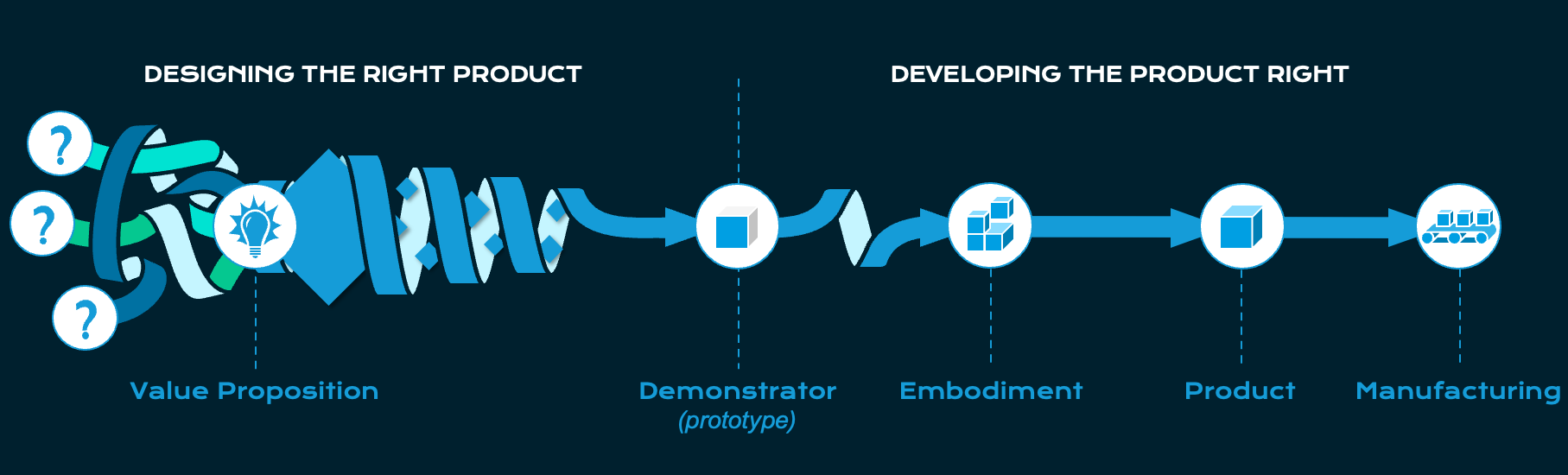
Our integrated development process
Good ideas are plentiful. Success lies in designing the right product early and then developing it in a way that is reliable and scalable. We work integrally, with one team and a lean process, so we learn faster, make risks visible early and base decisions on stronger grounds. That way you reduce late changes, avoid costly iterations and make the move to production feasible, predictable and manageable.
From concept to manufacturable product: the development trajectory
A manufacturable product does not arise in one step but through a trajectory in which design and production are repeatedly aligned.
Technical feasibility analysis in the concept phase
Even at the first sketch it is useful to test whether an idea is technically feasible. Which material suits the load and environment of the product? Which production technique is realistic for the expected quantities? Asking these questions early prevents a concept from having to be revised later.
Iteration between design and engineering
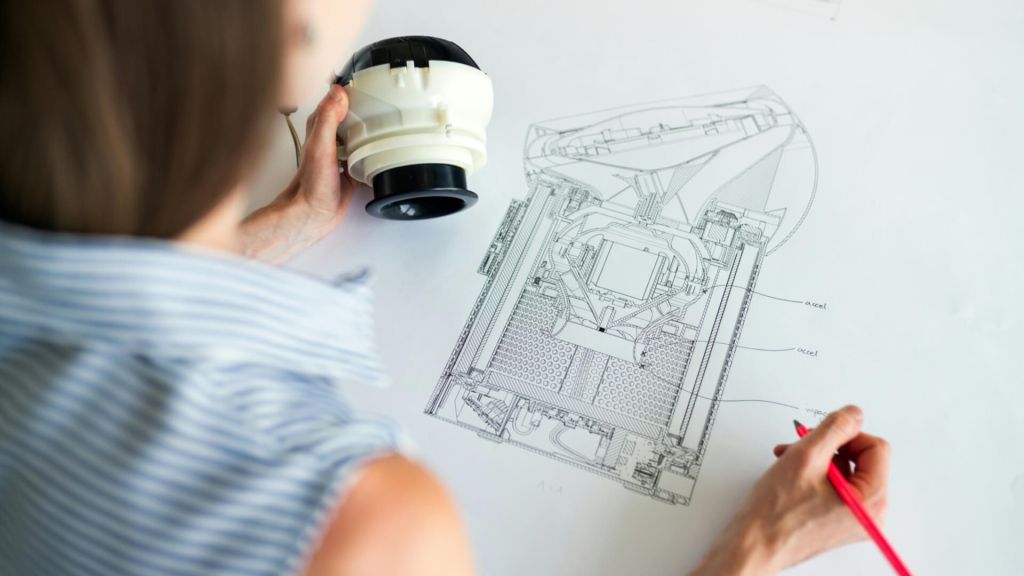
From there it is not a straight line, but back-and-forth between design and engineering. An industrial designer works on form and function while an engineer looks at wall strength, tolerances and production feasibility. Feedback from production specialists is already fed back into the design at that time, rather than only after completion.
From prototype to small-series production
Once a design has sufficiently crystallised, a prototype follows and often a test series in small batches. That is the moment when the last manufacturability issues come to light, before larger-scale production begins. PEZY supports companies from the first product idea to small-series production, with in-house expertise in industrial design, engineering, plastics and production under one roof. This ensures these steps are not isolated, but are carried out in conjunction.
Manufacturability in product design: materials and production techniques
Material and process decisions directly determine how manufacturable a design is, and they work both ways: the design steers the material choice, but the chosen technique in turn limits design freedom.
Plastic selection and injection-moulding considerations
In injection moulding, choices such as wall thickness, draft angle and the positioning of gates directly determine whether a design can be produced without post-processing or defects. A wall that is too thick can lead to shrinkage or visible sink marks, while an incorrect draft angle makes it difficult to eject the product from the mould. These choices should not only come to the mould maker’s table later, but be considered already in the first 3D model.
When 3D printing, CNC or moulds are the right choice
The production technique sometimes constrains what can be designed early on, and that should be a conscious choice, not an accident. 3D printing suits prototypes and small quantities with complex geometry. CNC machining fits precision parts in limited volumes. Moulds and injection moulding only become economical for larger series, but they require a design that takes the mould into account from the start. If you make this choice late, you are effectively designing blind for the production step that follows.

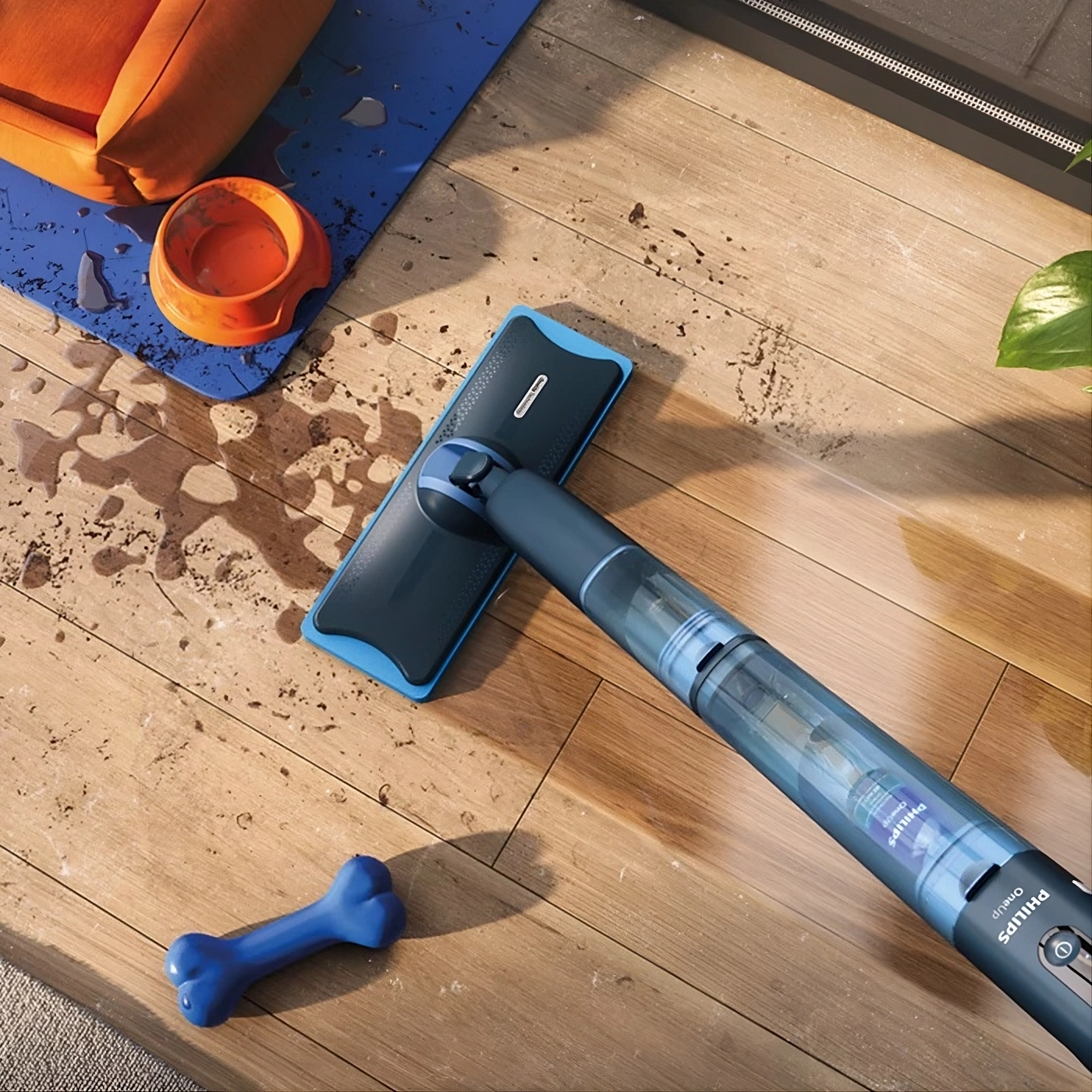
Case: Philips OneUp
In developing a new generation of floor cleaners, Philips had a clear ambition: an electronic mop that cleans faster and is more user-friendly than existing solutions.
In practice the challenge proved greater. Traditional mops use a bucket and reuse the same water, which can spread dirt across the floor. Electric floor cleaners partly solve that, but are often large, heavy and difficult to manoeuvre.
Manufacturable innovation: how a full-service development partner makes the difference
Manufacturable innovation arises when design, engineering and production are not organised separately, but as one continuous process.
Why separate specialists increase DFM risks
When a design agency, an engineering firm and a manufacturer work separately, noise quickly appears. A designer draws something that is aesthetically correct, but the engineer must rescue it technically later. The manufacturer then discovers last that a detail is not manufacturable, when the mould has already been ordered. Each handover between parties is a moment when manufacturability problems can arise or go unnoticed.
What an end-to-end partner delivers in practice
A partner that controls the entire process, from industrial design to engineering, plastics and production, can largely remove those handover moments. Decisions about material, wall thickness or assembly are then made by people who also know what happens further down the line. That reduces the risk that a manufacturability issue only emerges late, and it makes iterations between design and production faster and more direct.
DFM checklist: practical questions for your product design
A compact checklist helps to test early whether a design is on track to become production-ready.
Questions to ask early in the process
As an R&D lead or product manager, ask yourself among others these questions. How many separate parts does the design contain, and can that number be reduced? Which tolerances are truly necessary and which are unnecessarily tight? How many assembly steps and fasteners are there, and can that number be reduced? Does the material choice match the expected production volumes and the product’s load? And has the chosen production technique been considered early in the design, rather than being relied on afterwards?
Signals that a design is not yet production-ready
A number of signals indicate that a design is not yet ready for production. Parts only fit together one way. Many different screw or fastener types are required. Wall thicknesses vary widely without a clear functional reason. Or no one on the team can say with certainty how the product will eject from the mould. If you recognise any of these signals, it is time to reassess manufacturability.
Are you unsure whether your design is production-ready, or do you want certainty before investing in tooling? A technical feasibility scan or DFM review at PEZY identifies where the risks lie and what is needed to move from concept to reliable production.
From insight to results