Product design for medical devices: what requires extra attention?
Medical product development requires an integrated approach in which patient safety, traceable risk control and MDR/ISO requirements jointly guide design, material selection and manufacturability from day one, with the aim of a reproducible and certifiable product.
In brief
- Risk management according to ISO 14971 runs continuously through the process; MDR-compliant design controls and technical documentation grow in parallel; ISO 13485 (V-model) and early classification determine scope, planning and evidentiary burden.
- Material selection is about more than biocompatibility: sterilisation and chemical resistance, shrinkage and flow behaviour also matter; PEEK/PSU are commonly used for diagnostic disposables; always validate the end product because process parameters influence the biological response.
- Prototyping is done with production intent to obtain representative data; special processes require IQ/OQ/PQ process validation which can significantly affect lead time; scaling to small series introduces new variables that must be actively managed to ensure consistent quality.
Developing a medical device is a different discipline to designing consumer electronics. Every design choice must be directly linked to patient safety and traceable risk control within the framework of the MDR. As a product manager or R&D lead you are not looking for an agency that only sketches, but a partner who understands that an innovative idea only has value when it can be produced reproducibly and in regulatory compliance.
Product design for medical devices therefore requires an approach in which engineering, materials science and quality assurance come together from day one, rather than being added afterwards. In the medical sector, “manufacturable innovation” is not a slogan but a necessity: every design decision must be traceable to a risk assessment and production capability.
The unique requirements of product design for medical devices
Medical product development differs fundamentally from standard industrial design: functional safety and clinical performance always outweigh aesthetics or unit cost. A consumer product fails when the user is disappointed. A medical device fails when patient safety is endangered or the device’s performance cannot be guaranteed under all conditions.
Why medical design differs from consumer products
With consumer products, market feedback drives the iteration process. With medical technology, clinical requirements and risk classification dictate the development direction before a single sketch is made. You must account for traceability requirements that begin in the concept phase, not only at final validation, which means every change must be documented and assessed for impact.
This calls for a design mindset in which manufacturability and certification are developed in parallel with functionality.
Risk management as a constant thread in the design process
Risk management according to ISO 14971 is not an administrative exercise at the end of the project, but a continuous process that guides every technical decision during development. If you identify and mitigate risks early with design measures, you avoid costly redesigns in later stages, where the cost of changes increases exponentially.
A specialised medical device design bureau integrates these risk assessments directly into the technical specifications, so the final product is both safe and certifiable.
MDR-compliant product development as a foundation
Regulation is often seen as a constraint. MDR-compliant product development actually provides a clear framework that lets you realise innovation in a structured and predictable way, without unexpected blockers during certification. If you apply design controls early, your team will not discover at the audit stage that essential validation steps are missing or that the technical documentation does not match the physical product.
Design controls according to ISO 13485 in practice
ISO 13485 product development requires you to demonstrate how customer and regulatory requirements have been translated into product specifications, and how these have subsequently been validated via a structured V-model. You define clear entry and exit criteria for each design phase so that the transition from concept to detailed design proceeds in a controlled manner and remains fully traceable for audits.
In doing so you build a technical file that grows with the product.
Classification and the impact on the development trajectory
The classification of your device determines the level of evidentiary burden, and thus the lead time and investment required for market access. A class I product demands a different approach to clinical evaluation and post-market surveillance than a class IIa system, with direct consequences for the planning of your medical product development.
Establish this classification early, as it prevents scope creep and budget overruns.
Technical documentation in parallel with engineering
Technical documentation must never be an afterthought drawn up only after engineering is finished. That inevitably leads to gaps and inconsistencies in the technical file. Let the documentation grow in parallel with the design process, and the product description will remain synchronous with the actual realisation and test results, which significantly accelerates the conformity assessment.
Material selection and medical biocompatible plastics
If you are having a plastic medical device manufactured, material selection is a critical step that goes beyond requesting a standard ISO 10993 certificate from a supplier. Medical biocompatible plastics must not only be safe in contact with tissue, but must also retain their mechanical and chemical properties after sterilisation and throughout the product’s service life.
Selection criteria for medical plastics
In the development of diagnostic disposables, PEEK or PSU are often chosen because of their combination of sterilisation resistance and mechanical strength, despite higher processing temperatures that require specific moulding technology. In addition to biocompatibility, consider shrinkage, flow behaviour and resistance to cleaning agents: these factors determine dimensional stability and functionality in practice.
Incorrect material choices often lead to failed validations at a late stage.
Biocompatibility testing and material validation
A certificate from the raw material manufacturer is only an indication. Final biocompatibility is determined by the complete production process, including additives, colourants and surface treatments. Always validate on the end product as it comes out of the mould, because process parameters such as melt temperature and cooling time can influence the chemical structure and thus the biological response.
Engineering medical equipment therefore requires material expertise that accounts for both chemical composition and production process parameters.
Processing properties versus clinical requirements
There is often tension between the ideal clinical properties of a material and the practical processability in injection mould tools for small series. A material can be theoretically perfectly biocompatible, but if it cannot be processed stably without internal stresses or porosity, it still poses a risk to patient safety.
Our expertise inmedical-grade plastic engineeringhelps you find this balance.
From prototype to small-series production of medical devices
The transition from prototype to series production in the medical industry is not a linear step but a validation trajectory in which the production process itself is tested as rigorously as the product design. Small-series production of medical devices requires you to demonstrate that the process consistently delivers products meeting the established specifications and safety standards under variable conditions.
Prototyping with production intent
Prototyping for medical devices differs fundamentally from consumer prototyping. The aim is not only form verification, but also collecting process data for later validation. Throughrapid iteration via rapid prototypingyou test the feasibility of critical tolerances and material properties early, using production methods representative of the eventual series production.
This prevents you validating on a prototype that never proves manufacturable in series.
Validation of the manufacturing process
Process validation according to IQ/OQ/PQ protocols is mandatory for special processes such as injection moulding, where the output cannot be fully verified by inspection afterwards. For complex plastic components, process validation can account for up to 30% of the total development time, demonstrating that production engineering in a compliant project weighs as heavily as product design.
You invest this time upfront to eliminate later batch rejections and supply risks.
Scaling up without quality loss
Scaling from a pilot run to a small series introduces new variables, such as mould temperature distribution and cycle stability, which may not have been visible in the laboratory setting. Oursmall-scale production methodologyis specifically configured for these medical volumes, giving you assurance of quality without having to invest immediately in high-volume tooling.
PEZY supports customers from the Break-through Session through to series production, ensuring technical choices are always tested against our own injection moulding and assembly capabilities.
Engineering medical equipment: manufacturability at the centre
Engineering medical equipment combines functional performance with reproducible manufacturability, because variation in production directly affects clinical safety and device reliability. A design that works perfectly on paper but is sensitive to minimal process tolerances is, by definition, a poor design in medical practice: it leads to quality issues and potential recalls.
Design for Manufacturing in a regulated context
Design for Manufacturing (DFM) gains an extra dimension under the MDR, because manufacturability optimisations must never compromise validated performance or safety. Consult ourpractical guide to Design for Manufacturingto see how to systematically assess design changes for their impact on both production efficiency and compliance requirements.
This reduces failure costs in later production runs and accelerates time-to-market by minimising subsequent mould adjustments.
Tolerance chains and functional safety
Tolerance analysis in medical equipment is not a theoretical exercise but a direct reflection of the risk assessment for critical functions such as dosing accuracy or electrical insulation. You must demonstrate that the summation of individual component tolerances remains within the safe margin, even for worst-case combinations that are statistically rare but clinically relevant.
This requires a meticulous link between CAD models and risk files.
Why an end-to-end partner reduces risks
Separating design and production for medical devices often leads to information loss, delays in change control and disputes about responsibility when validations fail. A full-service product innovation partner that controls both engineering and plastic production safeguards the continuity of knowledge and ensures a consistent interpretation of quality requirements throughout the project.
Knowledge retention between design and production
When the party that designs the product also builds the moulds and produces the series, the context of every design decision is preserved during industrialisation. This shortens feedback loops during validation significantly, because there is no need to translate between an external design agency and a separate manufacturer that do not share the same assumptions.
This prevents crucial nuances from being lost in transfer documents.
A single point of contact for compliance and engineering
Under the MDR you remain the manufacturer with ultimate responsibility, but the execution of design controls and process validation often lies with external parties whose working methods must align with your quality system. By choosing astructured product innovation trajectorywith a single partner, you integrate technical realisation and compliance into one manageable process with clear accountability.
This gives you, as an R&D leader, the control needed to deliver predictably.
Practical examples from the medical product category
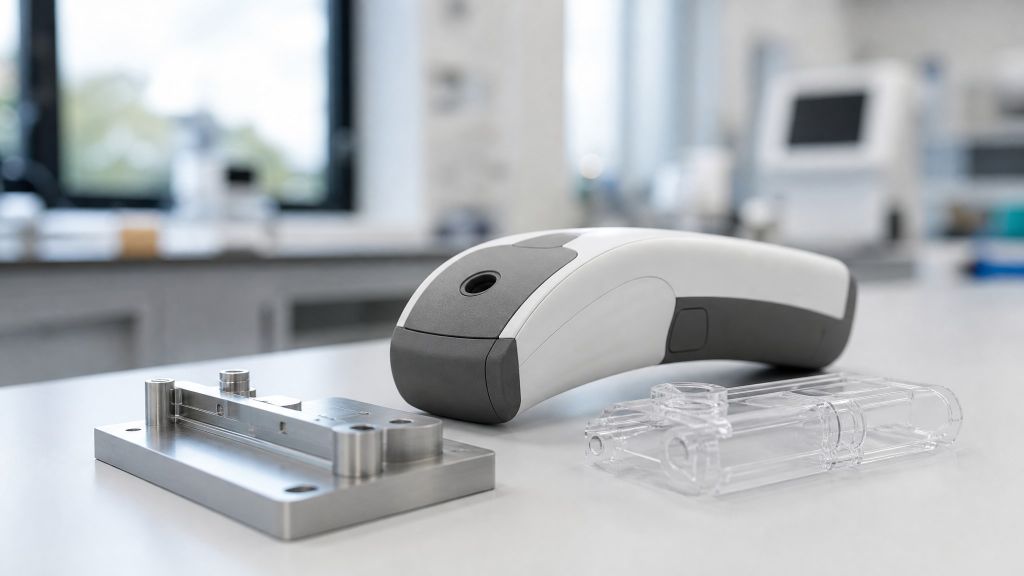
Theoretical frameworks around risk management and biocompatibility only become meaningful when translated into physical products used daily in healthcare. Looking at completed projects, you can see how manufacturability and regulation come together in tangible results, ranging from sterile disposables to complex housings for diagnostic equipment.
This experiential knowledge is often more valuable than generic guidelines when estimating feasibility and lead time for your specific innovation challenge.
We gladly invite you to a non-binding Break-through Session to make your medical design challenge concrete and assess feasibility within the MDR framework.
From insight to results