Product development costs: the most expensive choices are made at the start
When companies consider the costs of product development, attention often goes to engineering hours, prototypes or the investment needed to further develop an idea. That is understandable. Development costs are visible, appear on a quote and are often the first topic of conversation.
In brief
- The cost of product development is not only determined by engineering hours or prototypes, but mainly by the design choices made early in the process.
- General price ranges give only a limited indication, because complexity, volumes, choice of materials, tolerances, certification and production approach vary greatly from product to product.
- Starting cheap can be expensive later on when makingability, assembly, material behaviour and scalability are not sufficiently early.
- Through DFM, smart material choices, prototyping and early validation, development costs and production costs can be better managed.
Yet development costs tell only part of the story. The real cost of a product is not determined solely by the number of hours engineers spend on a design, but above all by the choices made during the development process. A material that is difficult to process, a component that turns out to be unnecessarily complex, or a housing that requires lengthy assembly time can affect a product’s cost price for years.
That is why it is often said that a large portion of the final product costs are established during the design phase. Not because the product has already been manufactured, but because the most important decisions are made at that moment. Focusing only on development costs therefore risks losing sight of the product’s total cost.
How much does product development cost on average?
There is no simple answer to the question of what product development costs. The differences between projects are simply too great. A relatively simple plastic housing requires a different investment than a medical device, a consumer product with electronics, or a complex product combining mechanics, software and electronics.
General price ranges are often mentioned online. Depending on complexity, costs can range from a few thousand euros for a simple design task to more than a hundred thousand euros for complete product development including engineering, prototyping, validation and production preparation. Such figures can help give an initial sense of scale, but they say little about the eventual investment required to bring a product to successful production.
Two projects with the same development budget can produce totally different outcomes. The difference is not only in the amount of engineering performed, but mainly in the quality of the choices made during that process. A well-founded design may require more attention during development, but later lead to lower production costs, fewer failures and a shorter route to scaling up.
Why general price ranges say little about product development
Many organisations start their search by asking what product development costs. That is a logical starting point, but also a question that is hard to answer without context. Final costs are influenced by dozens of factors, including product complexity, desired volumes, material choice, tolerances, certification requirements, assembly, test methods and the way the product ultimately needs to be manufactured.
A product produced in a small series requires different choices than a product that needs hundreds of thousands of units per year. In the first case flexibility may be more important than maximum automation. In the second case a small optimisation in material use, cycle time or assembly can have a major financial impact over the product’s lifetime.
That is why a low quote for product development is not automatically the most advantageous choice. When important technical issues are resolved only later in the process, costs shift to a phase where changes are often far more expensive. A design change in the concept phase is relatively straightforward. A change after tooling has been ordered, prototypes validated or production partners selected often has much greater consequences.
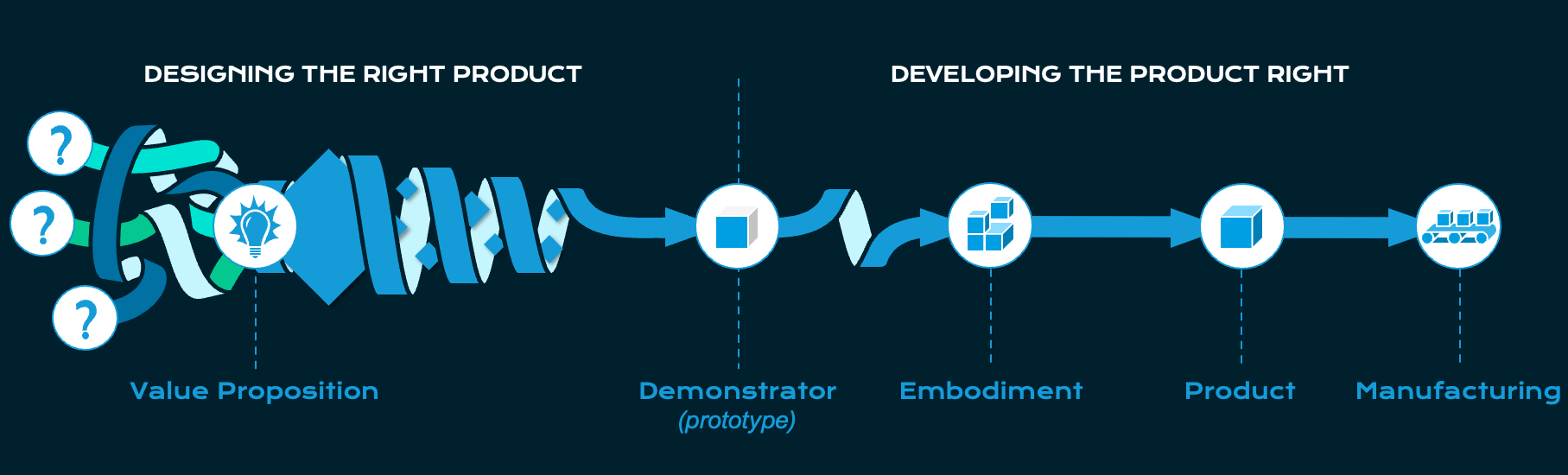
Our integrated development process
Good ideas are plentiful. Success lies in designing the right product early and then developing it in a way that is reliable and scalable. We work integrally, with one team and a lean process, so we learn faster, make risks visible early and substantiate decisions better. This reduces late changes, prevents costly iterations and makes the step to production feasible, predictable and controllable.
The biggest cost is not the design, but uncertainty
Many companies try to keep development costs as low as possible. That seems logical, especially when budgets are under pressure or when it is not yet clear whether a product will be commercially successful. Yet the largest cost item in product development often does not arise from engineering itself, but from uncertainty that remains in the process for too long.
Uncertainty about the manufacturability of a design, material behaviour, tolerances, assembly or real-world performance often means problems only become apparent late. For example during the pilot phase, the first production run or even after market introduction. At that moment changes are significantly more expensive than if the same choices had been investigated and validated earlier.
That is why experienced product developers invest relatively much attention in the early phases of a project. Not to make the development process needlessly long, but to make risks visible early. An extra iteration in the engineering phase can prevent far more costly work later. The same applies to a prototype that not only shows how a product looks, but also tests whether it is technically, functionally and production-wise correct.
What do product development costs consist of?
Although every project is different, product development usually comprises a number of recurring elements. The first phase is about clarifying the product requirements. What function must the product fulfil? Who will use it? Under what conditions must it perform? Which technical, commercial and legal constraints are important?
Next follows concept development. In this phase different solution directions are explored and weighed up. Not every concept that is technically possible is sensible to manufacture. That is why choices are often already made in this phase that later determine material use, assembly, cost price and scalability.
The design is then developed technically. Materials are selected, tolerances determined, components constructed and calculations performed to substantiate the product’s performance. In this phase it often becomes clear whether a product is easy to manufacture or whether the design contains unnecessary complexity.
After engineering usually comes a prototyping phase. Here it becomes visible whether the design behaves in practice as expected. Functional tests almost always yield new insights. Sometimes these lead to small optimisations, sometimes to choices that need to be reconsidered. After that come validation, preparation of tooling, production processes, quality assurance and ultimately the transition to serial production.
So the costs of product development are not in one phase, but in the coherence between all these steps. Decisions made early on almost always influence the costs and risks in subsequent phases.
Why starting cheap can become expensive later
A low development price seems attractive, especially when several parties submit a quote for the same product idea. Yet in practice it often turns out that cheap development ultimately leads to higher total costs. This happens mainly when insufficient attention is paid in the early phase to manufacturability, material choice, tolerances and production preparation.
A design that is not optimised for production can, for example, consist of more parts than necessary. That means extra assembly time, greater chance of errors and a higher cost price per product. A design may also function technically but be difficult to reproduce in serial production. In that case the costs only appear when the step to production is taken.
Material choice is another example. A cheaper material may seem attractive at first glance, but can lead to longer cycle times, higher scrap rates, assembly limitations or insufficient real-world performance. The same applies to tolerances. Unnecessarily tight tolerances make components more expensive to produce, while they are not always functionally necessary.
Each individual choice may seem small. Together they determine a product’s cost price, quality and reliability for years. That is why more and more organisations look not only at development costs, but at total costs over the full lifetime of a product.

Case: Philips OneUp
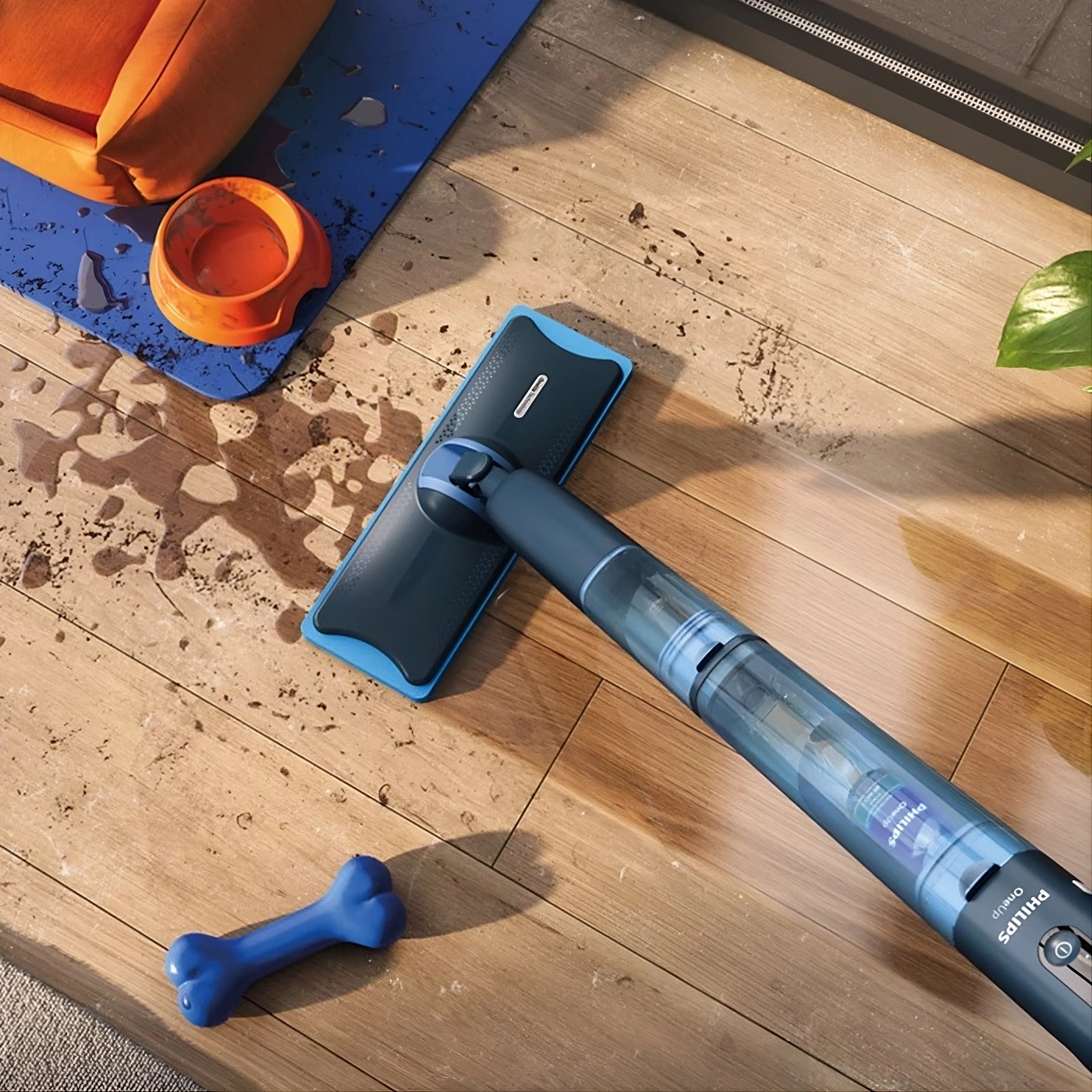
When developing a new generation of floor cleaners, Philips had a clear ambition: an electronic mop that cleans faster and is more user-friendly than existing solutions.
In practice the challenge proved greater. Traditional mops use a bucket and reuse the same water, which can spread dirt across the floor. Electric floor cleaners partly solve that, but are often large, heavy and hard to manoeuvre.
How DFM, material choice and prototyping reduce costs
An important element of modern product development is Design for Manufacturing. The principle is that a product must not only function, but also be manufacturable efficiently. This requires design decisions that consider production, assembly, material behaviour and scalability from the outset.
DFM helps reduce complexity. This can be done by reducing the number of parts, solving fastenings more cleverly, making tolerances more realistic, or better aligning a design with the chosen production process. In plastic product development this can, for example, mean taking wall thicknesses, draft angles, rib structures and material flow into account early in the design.
Material choice also has a major effect on total costs. The right material is not automatically the cheapest material per kilo, but the material that is technically, production-wise and economically the best fit for the application. Factors such as strength, stiffness, temperature behaviour, wear, processing, sustainability and availability all play a role.
Prototyping makes it possible to test assumptions early. A good prototype is more than a visual check. It demonstrates whether a product functions, how parts interact, how users handle it and where technical or production risks lie. Because prototypes can be adjusted relatively quickly, they are an effective means of preventing larger costs later in the process.
The value of prototyping therefore lies not only in the prototype itself. The real value is the insight gained before investments in tooling, certification or production capacity are made.
When existing products are cheaper to optimise than developing new products
Innovation does not always mean developing an entirely new product. Many existing products were designed years ago based on the knowledge, materials and manufacturing techniques available at the time. Since then production processes have improved, new materials have become available and requirements around sustainability, circularity and cost-efficiency have changed.
As a result it can be worthwhile to review an existing product. Can the number of parts be reduced? Can assembly be simplified? Can a different material choice lower the cost price? Can the product be made suitable for a more efficient production process? Or are there design choices that once made sense but are no longer the best solution today?
In many cases optimising an existing product yields more than starting from scratch. The foundation already exists, practical experience is available and often the bottlenecks are known. This makes it possible to improve more purposefully. Especially for products already produced in larger volumes, a small improvement in material use, assembly time or scrap rate can have a large impact.
The question is therefore not only what it costs to develop a new product. Equally relevant is how much value is still hidden in the product already being produced today.
How PEZY keeps costs manageable from concept to pilot series
At PEZY we view product development as a process in which development costs, production costs and Total Cost of Ownership are interconnected. Of course development costs must remain controllable. But equally important is what that investment yields during the years a product is manufactured, assembled, used and maintained.
That is why engineering, Design for Manufacturing, material choice, prototyping and production preparation are not treated as separate steps, but as parts of one coherent development process. By thinking early about manufacturability, material behaviour and production volumes, design choices can be better substantiated before they become costly later in the process.
The combination of product development, prototyping, tooling and pilot production makes it possible to validate assumptions early and adjust where necessary. That reduces technical risks, prevents unnecessary iterations and ensures that products not only function well but can also be produced efficiently.
Ultimately product development is not about achieving the lowest development costs. It is about making the right choices at the right time. Choices that ensure a product becomes more manufacturable, more reliable and more cost-efficient.
And those choices are usually made at the beginning.
From insight to results