
Right to Repair: what is the impact on product development?
From 31 July 2026, uniform rules on the Right to Repair will apply across the European Union. This means that repairability will become a standard design requirement for many products. For manufacturers, this is not just a compliance issue, but also a strategic opportunity. Those who incorporate repairability into product development at an early stage will create products that are more future-proof, more sustainable and commercially stronger.
Leestijd: 7 minuten

Summary
- From 31 July 2026, uniform rules on the Right to Repair will apply across the EU.
- Repairability will therefore become a mandatory requirement in product development, rather than merely a nice-to-have feature.
- Manufacturers must take into account parts availability, technical documentation and design for disassembly.
- Those who integrate repairability at an early stage will limit compliance risks whilst creating both commercial and sustainable benefits.
From 31 July 2026, uniform rules on the Right to Repair will apply across the European Union. Directive EU 2024/1799 makes the repair of faulty goods simpler, cheaper and more attractive for consumers. For manufacturers, this represents a fundamental shift in product development.
Repairability is becoming a legally required product characteristic. At PEZY, with over thirty years’ experience in innovative product development, circularity and industrialisation, we do not view this as an administrative burden. We see it as a strategic opportunity to create sustainable and future-proof products.
We would like to provide you with an insight into the background, the specific implications for product development and the practical considerations. This demonstrates how PEZY supports this transition from the concept phase through to mass production. In this way, products comply with legislation, retain their value and contribute to a circular economy.
1. What exactly is the Right to Repair?
The Right to Repair gives consumers the legal right to have a faulty product repaired rather than replaced. This can be done by themselves, an independent repairer or the manufacturer. The scheme is based on three key principles:
1. Access to spare parts at reasonable prices for a minimum period of seven to ten years after the last unit has been placed on the market.
2. The availability of technical information, tools, diagnostic software and manuals without unnecessary barriers.
3. The ban on artificial barriers such as parts pairing, whereby a new component only works after manufacturer approval, the bonding of components, or the use of proprietary screws.
The directive applies to a wide range of consumer goods, including washing machines, vacuum cleaners, fridges, smartphones, laptops and other electronic devices.
Repairs must remain possible and affordable even after the statutory warranty period has expired. If a repair is carried out instead of a replacement, the warranty is extended by at least twelve months. In addition, a European repair information form will be introduced, and from 2027 there will be an EU-wide online Repair Platform where consumers can find independent repairers.
In the Netherlands, implementation is in full swing. The bill is currently being debated in the House of Representatives and the Senate and is expected to come into force in the course of 2026. The directive follows a full harmonisation approach. This means that Member States may not introduce stricter or more lenient rules unless explicitly permitted to do so.
2. Legislative context and timeline
The Directive was adopted on 13 June 2024 and entered into force on 30 July 2024. Member States must transpose it into national law by 31 July 2026 at the latest. In the Netherlands and most other Member States, transposition had not yet been completed by March 2026, but the deadline is fast approaching. It is important to note that the obligations apply to all products within the scope, including those sold before 31 July 2026. This creates a sense of urgency for existing product portfolios.
The directive forms part of the broader European Green Deal and circular economy strategy. It builds on earlier initiatives such as the Ecodesign Regulations, which already set repair requirements for specific product groups, and national experiments such as the French Repairability Index.
3. Implications for manufacturers and product development
The impact extends beyond compliance. Repairability is becoming a new legally required product feature. This affects design, cost structure, the supply chain and the business model.
The positive effects are clearly evident. Products that are easy to repair remain in use for longer. This strengthens brand loyalty and opens up new revenue streams through repair, upgrade and refurbished services. The circular economy is gaining ground, with less e-waste, lower consumption of critical raw materials and a smaller carbon footprint. Companies that proactively design for repairability score higher in sustainability reports and find it easier to meet future requirements such as the Ecodesign for Sustainable Products Regulation.
Challenges and risks deserve serious attention. Integrating modularity and disassembly at an early stage often requires additional investment in research, product development and tooling. Those who delay taking this step run the risk of facing costly redesigns, delays or fines later on. At the same time, broader access to firmware and components brings new risks, such as counterfeiting, unsafe repairs and a loss of quality.
For manufacturers, the challenge therefore lies in striking the right balance between transparency and the protection of intellectual property. There are also economic considerations. Some studies point to potential price rises or a shift towards cheaper, less sustainable products. An earlier analysis by the University of California even painted a bleak picture for certain markets, with lower margins, fewer benefits for consumers and more waste due to an increase in cheap replacements. On top of that, the supply chain is becoming more complex. Maintaining a parts inventory for seven to ten years requires more accurate forecasting and stronger, strategic partnerships with suppliers.
In short, those who treat repairability as an afterthought will pay the price later on. Those who integrate it from the design stage onwards turn a liability into a strategic advantage.
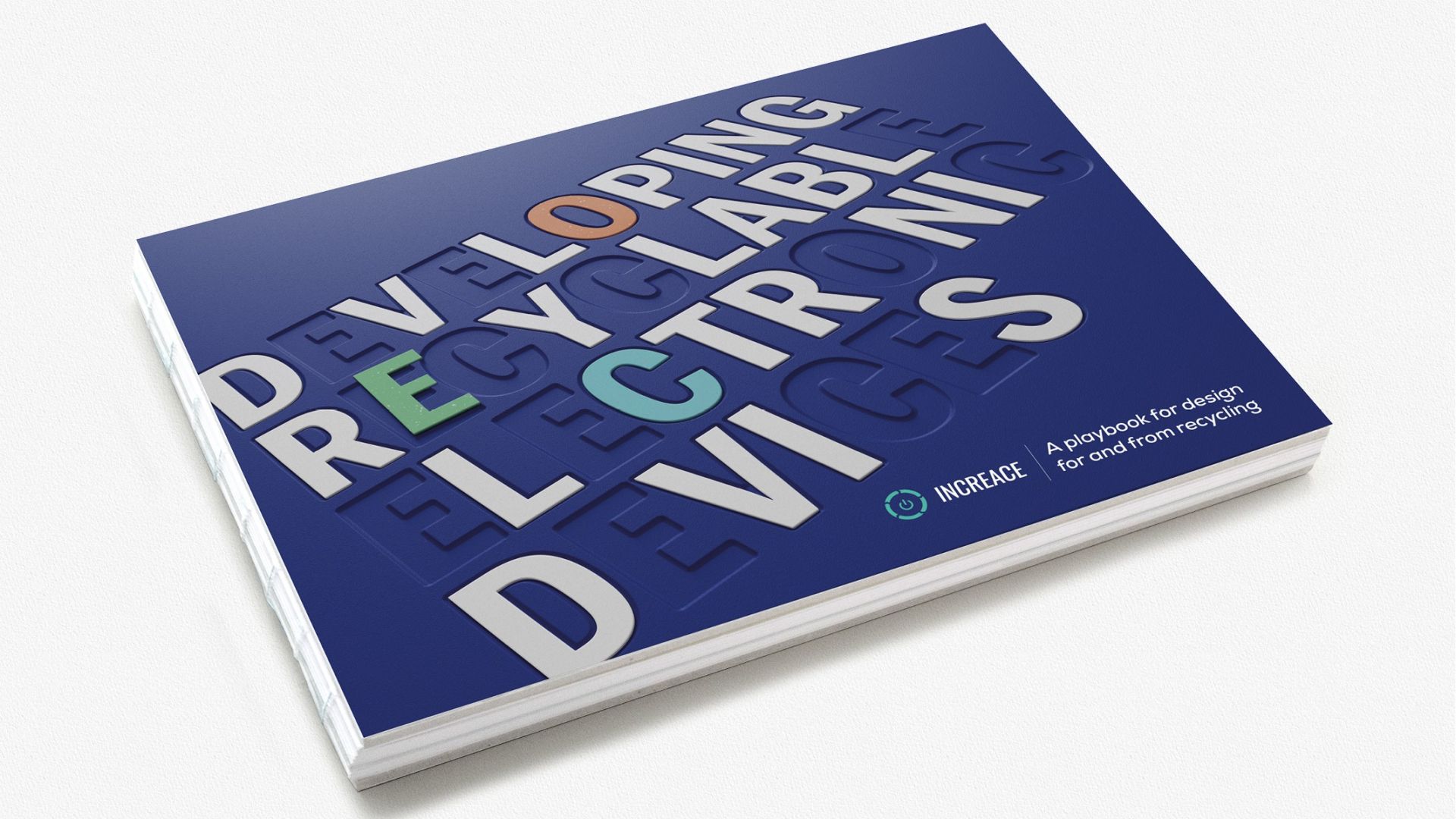
Request a free copy of the book now: Developing Recyclable Electronic Devices
This handbook provides practical guidance for product developers and engineers in the consumer electronics sector who wish to design using recycled plastics and develop products that are genuinely suitable for high-quality recycling.
4. Design for Repairability: the core principles of product development
More than 80% of a product’s environmental impact and reparability is determined during the design phase. PEZY employs a holistic ‘Repair-Oriented Design’ framework that combines technical, user-friendly and circular aspects. Within this framework, we address the following key principles:
Durability and robustness form the foundation.
Choose materials and designs that can withstand physical wear and tear and emotional obsolescence. Carry out extensive lifespan and stress tests. A product that rarely breaks down requires fewer repairs.
Easy disassembly improves usability.
Use standard screw connections instead of adhesive, clips or special tools. Ensure that critical components such as the battery, display, sensors and printed circuit board can be removed without damage or the need for a tool kit. Simulate disassembly in CAD and virtual twins to eliminate bottlenecks at an early stage.
Modularity and upgradeability make all the difference.
Design using replaceable modules. This not only makes repairs quicker and cheaper, but also enables future upgrades. A modular electronics architecture in which software and hardware evolve independently provides a prime example of this.
Diagnostics and documentation lower the barrier to entry.
Integrate built-in diagnostic tools and QR codes linking to detailed public manuals. Provide comprehensive repair instructions, parts lists and exploded views. This lowers the barrier to entry for both consumers and independent repairers.
Safety, circularity and design from recycling bring everything full circle.
Ensure that hazardous components, such as batteries and chemicals, are removed safely. Use recycled materials and design the product so that it is easy to recycle at the end of its life cycle.
A practical checklist for product developers includes specific questions.
Can each module be dismantled within five to ten minutes? Are parts numbered and labelled? Does the software comply with open standards without any lock-in mechanisms? Has a repair score, such as the French index, been incorporated into the marketing?
PEZY incorporates these principles into an integrated development process. From strategy and concept through engineering and prototyping to industrialisation in our own PEZY Pilot Factory, we test repairability under realistic conditions. In this way, we validate compliance and optimise for mass production.
5. PEZY’s approach: from legislation to competitive advantage
At PEZY, circularity and repairability are not isolated pillars but a common thread running through the entire development process. We combine design thinking, materials expertise, engineering know-how and manufacturing capacity all under one roof. Clients in the healthtech, consumer electronics and industrial equipment sectors benefit from this. Products not only comply with regulations but are also emotionally sustainable and have a positive impact on both the environment and business.
Our experience shows that incorporating design for repairability at an early stage reduces time to market and minimises risks. We assist with spare parts strategies, cost optimisation and preparation for the EU Repair Platform. The result is future-proof products that retain their value for longer.
Ready for 2026 and beyond?
The deadline of 31 July 2026 is closer than it seems. Manufacturers who invest now in repair-friendly product development will not only avoid compliance risks but also build a stronger, more sustainable market position.
At PEZY, we’re here to help make your product portfolio future-proof. Whether it’s a new concept, a redesign of existing products or a comprehensive circularity strategy, we provide the expertise and facilities required.
Ready to talk?
We work with companies that want to successfully develop products or components. Together, we achieve the best results, from initial concept through to production.

 PEZY is officially certified as a Great Place To Work™. This recognition is based entirely on feedback from our employees.