
Design for Manufacturing: A Practical Guide to Manufacturable Product Designs
A strong product design must deliver more than functionality and visual appeal—it must also support efficient, scalable production. Design for Manufacturing integrates design, engineering, material selection, and production from the earliest stages. This article shows how DFM reduces costs, delays, and production risks, guiding you from concept to a reliably manufacturable product.
Reading time: 8 minutes

- Design for Manufacturing embeds manufacturing processes, material choices, cost targets and production volumes into the design phase from day one.
- Validating manufacturability early eliminates expensive tooling revisions, repeated test cycles and launch delays.
- Design for Assembly further reduces part count, assembly steps and the risk of errors on the line.
- Integrating design, engineering, prototyping and production into one streamlined workflow delivers a reliable, production-ready product faster.
Engineers and product developers searching for a definition of Design for Manufacturing often encounter English-language or academic explanations that offer little actionable guidance for day-to-day practice. For an SME developing a new product, that falls short. This article delivers a practical perspective from the Netherlands: what DFM means, why it matters from the concept phase onward, and how the right questions turn a design into a truly production-ready product.
What Is Design for Manufacturing (DFM)?
DFM, in plain terms: designing a product so it can be manufactured efficiently, reliably, and at predictable costs. It’s not a theoretical model but a practical methodology that builds production realities into the design process from the outset. Most existing descriptions remain anchored in abstract principles drawn from handbooks and academic literature. In day-to-day product development at SMEs, DFM simply means preventing a strong concept from stalling on the production floor due to cost overruns, scrap, or delays.
Core Principles of Design for Manufacturability
Design for manufacturability rests on a few core principles. Minimize the number of components. Select materials and processes that align with your target production volumes. Design with the constraints of the chosen process in mind from the outset, not as an afterthought. And bring manufacturing expertise into the process well before the first drawing is finalized. This is exactly where many projects lose momentum: engineering and production are only connected once the design is already largely locked in.
DFM vs. Traditional Product Design
In a traditional design process, form and function take precedence, with manufacturability addressed only afterward. DFM reverses this sequence—or, more precisely, integrates design and manufacturability from the outset. The result is more than time savings: it eliminates downstream compromises that drive up costs or reduce reliability.
Why Manufacturability Matters from the Design Phase Onward
Most manufacturing costs and challenges are already locked in the moment a design is finalized—even if they only surface later. This makes the concept phase the decisive stage for product design and manufacturability, not the production phase itself.
Cost Impact of Late Design Changes
Revising a product design after the first mold is produced typically drives substantially higher costs and longer lead times than implementing the same change during the concept phase. Once tooling is ordered, design decisions are locked into steel. Any later adjustment then requires not only a new mold or rework, but also disrupts the project schedule and often triggers additional validation rounds.
Risks of Skipping DFM
In SME product development, manufacturability reviews often arrive too late. Launches slip while molds undergo repeated revisions before they perform reliably. Parts require unplanned secondary operations because wall thicknesses or draft angles fall outside specification. Assembly teams discover during first-run builds that components don’t mate cleanly. An early DFM assessment would have prevented every one of these setbacks.
Design for Assembly: The Connection to DFM
Within the DFM discipline, Design for Assembly is the focused subdomain dedicated to cutting the number of components and assembly steps to streamline integration. While DFM addresses the full production process, DFA targets the precise moment when all parts converge.
What DFA Adds to a Manufacturable Design
DFA complements DFM by examining the assembly line or station in detail: the number of operations required, the fasteners involved, and the process’s overall susceptibility to errors. A design may be fully manufacturable at the component level yet still prove difficult to assemble—for example, when it demands multiple screw types or restricts parts to a single mounting orientation.
Practical Design Rules for Simplified Assembly
Several design principles consistently deliver results in practice. Reduce fastener variants to eliminate repeated tool changes for assembly technicians. Design components with maximum symmetry to prevent incorrect orientation during installation. Incorporate self-centering interfaces so parts locate themselves automatically, removing the need for manual alignment. These are not rigid formulas but proven guidelines that measurably reduce assembly errors.
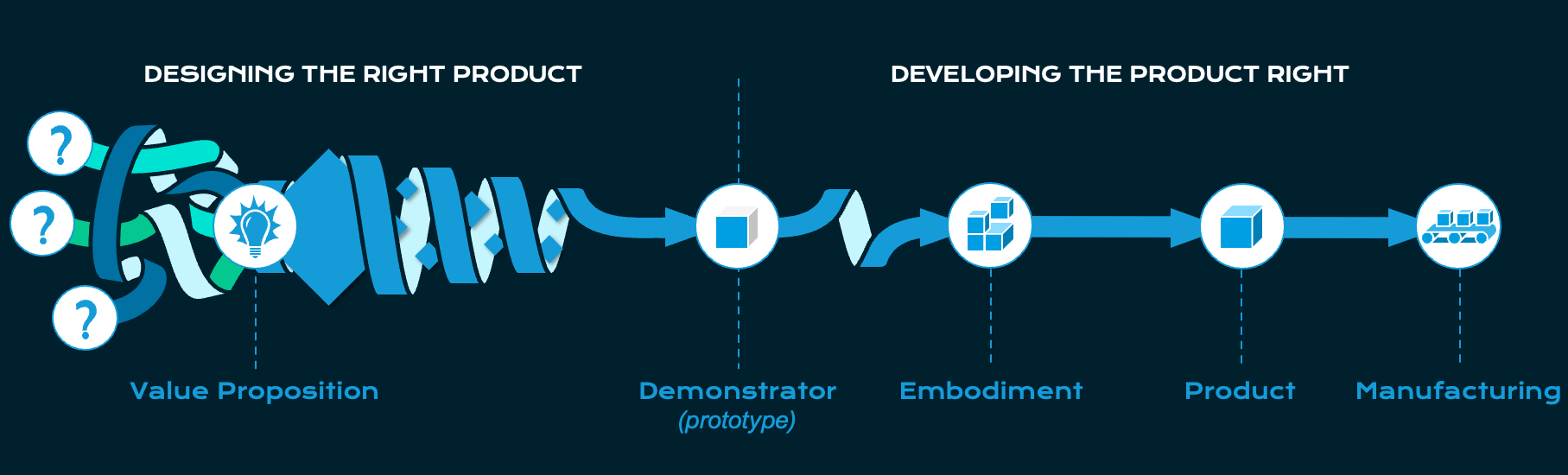
Our integrated development process
Good ideas are everywhere. Success depends on designing the right product from the start and developing it in a way that is reliable, manufacturable and scalable. We work as one integrated team with a lean development process, enabling us to learn faster, identify risks early and make well informed decisions. This reduces late design changes, prevents costly iterations and creates a smoother, more predictable transition to production.
From Concept to Manufacturable Product: The Development Journey
A manufacturable product is not created in a single step. It takes shape through an iterative process in which design and production are continuously aligned.
Technical Feasibility Analysis in the Concept Phase
From the first sketch onward, validating technical feasibility is essential. Which material aligns with the product’s loads and operating environment? Which manufacturing process remains viable at projected volumes? Addressing these questions early prevents downstream concept revisions.
Iterating Between Design and Engineering
From there, development becomes an iterative exchange between design and engineering rather than a straight path. Industrial designers focus on form and function, while engineers assess wall thickness, tolerances, and manufacturability. Input from production specialists feeds back into the design in real time, instead of only after completion.
From Prototype to Low-Volume Production
Once a design reaches sufficient maturity, the next step is prototyping—often followed by small-batch test series. This is the stage where final manufacturability issues surface, well before scaling to higher volumes. PEZY partners with companies from initial concept through to small-series production. With in-house expertise spanning industrial design, engineering, plastics, and manufacturing, these phases are executed as an integrated process rather than isolated steps.
Design for Manufacturability: Materials and Production Techniques
Material and process decisions directly determine a design’s manufacturability. The relationship runs both ways: the design steers material selection, while the chosen technique, in turn, restricts design freedom.
Polymer Selection and Injection Molding Considerations
In injection molding, decisions on wall thickness, draft angles, and gate positioning directly determine whether a design can be produced without secondary operations or defects. Excessive wall thickness, for example, causes shrinkage and visible sink marks, while insufficient draft angles complicate part ejection from the mold. These choices must be resolved at the initial 3D model stage—not deferred to the mold maker.
When 3D Printing, CNC, or Molding Is the Right Choice
Manufacturing methods can restrict design possibilities from the earliest stages—and that restriction must be a deliberate choice, not an afterthought. 3D printing suits prototypes and low-volume parts with complex geometries. CNC machining delivers precision components in limited runs. Tooling and injection molding reach cost efficiency only at higher volumes, yet demand designs that integrate mold constraints from the outset. Delaying this decision leaves the team designing without visibility into the production process that follows.

Case: Philips OneUp
When developing a new generation of floor cleaners, Philips had a clear ambition: an electric mop that cleans faster and is easier to use than existing solutions.
In practice, the challenge proved to be greater. Traditional mops use a bucket and reuse the same water, which can cause dirt to spread across the floor. Electric floor cleaners partially solve this problem, but they are often large, heavy and difficult to manoeuvre.
Feasible Innovation: How a Full-Service Development Partner Makes the Difference
Feasible innovation emerges when design, engineering, and production operate as one seamless, continuous process rather than isolated functions.
Why Disconnected Specialists Increase DFM Risks
When design agencies, engineering teams, and manufacturers operate in isolation, misalignment emerges quickly. A designer delivers a concept that meets aesthetic requirements, yet the engineer must later resolve technical constraints. The manufacturer, as the final link, often identifies unproducible details only after tooling has been ordered. Each handover between parties creates openings where manufacturability issues can surface—or remain undetected.
What an end-to-end partner delivers in practice
A partner managing the full trajectory—from industrial design through engineering, plastics, and production—eliminates most handoff points. Decisions on materials, wall thickness, or assembly are made by teams who understand downstream process realities. This reduces the risk of manufacturability issues surfacing late and accelerates direct iterations between design and production.
DFM Checklist: Practical Questions for Your Product Design
A compact checklist enables early validation of whether a design is on track toward production readiness.
Essential Questions to Ask Early in the Development Process
As an R&D lead or product manager, challenge your design with questions like these: How many separate components does it contain—and can that number be reduced? Which tolerances are essential, and which are overly restrictive? How many assembly steps and fasteners are involved, and can they be minimized? Does the material choice align with projected production volumes and the loads the product will face? And was the selected manufacturing process integrated from the start, rather than treated as an afterthought?
Indicators That a Design Is Not Yet Production-Ready
Several indicators suggest a design is not yet production-ready. Components assemble in only one orientation. Multiple screw or fastener types are required. Wall thicknesses vary significantly without a clear functional rationale. Or no team member can confidently explain how the product will eject from the mold. If any of these signals resonate, it is time to reassess manufacturability.
Uncertain whether your design is production-ready, or seeking clarity before committing to tooling? A technical feasibility scan or DFM review from PEZY pinpoints risks and defines exactly what’s required to move from concept to reliable manufacturing.
Ready to talk?
We work with companies that want to successfully develop products or components. Together, we achieve the best results, from initial concept through to production.

 PEZY is officially certified as a Great Place To Work™. This recognition is based entirely on feedback from our employees.