
Plastics Manufacturing: Injection Molding and Extrusion
Plastics manufacturing offers many possibilities, but success is largely determined by decisions made before production begins. The manufacturing process, material and product design collectively influence quality, costs, lead time and scalability. This article explains the available manufacturing techniques, when to choose injection moulding, extrusion or 3D printing and how to move from an initial prototype to reliable series production.
Reading time: 10 minutes

- The right manufacturing technique depends on the product geometry, material requirements, desired volumes and stage of product development.
- Aligning design, material selection and manufacturing at an early stage helps prevent costly redesigns, delays and quality issues.
- Prototypes and small production runs make it possible to validate both the product and the manufacturing process before investing in scaling up.
A strong product idea deserves a production process that doesn’t stand in its way. For many companies with a physical product on the roadmap, plastics manufacturing is the most logical route—yet the term covers a wide array of techniques, materials and decisions. In this overview, we walk through what plastics production actually involves, which processes exist, how to select the right material, and what to watch for when outsourcing production.
What is plastics manufacturing—and why do companies choose it?
Plastics manufacturing is the umbrella term for every process that converts raw material—typically plastic pellets or granules—into a functional component or finished product. This ranges from a compact electronics enclosure and a technical machine part to a consumer product produced in high volumes. The common thread: plastic is melted, shaped or processed into a product with a defined form and precisely engineered properties.
Definition and Application Areas of Plastics Production
Plastics manufacturing encompasses injection molding, extrusion, thermoforming and 3D printing. Each process serves its own application range, from one-off prototypes to production runs of hundreds of thousands of identical components. Plastics manufacturing is applied across virtually every sector: medical devices, consumer electronics, industrial machinery, packaging and automotive. What these industries share is the demand for lightweight, cost-effective and reliably reproducible parts.
Advantages of plastics over metal and other materials
Plastic offers several practical advantages over metal. First and foremost is weight: plastic components typically weigh considerably less than their metal counterparts. This benefits transport, assembly and end use. Plastic also provides extensive design freedom, as complex geometries, integral hinges and snap-fit connections can be realized relatively easily. In series production, the unit cost is often lower than with metalworking—particularly as volumes increase. What’s more, plastic is inherently corrosion-resistant, making it attractive for applications in humid or chemically aggressive environments. An SME manufacturer that switches from metal to plastic housings can cut weight and assembly time by tens of percent, provided the design is optimized for injection molding from the outset.
Key Plastics Production Processes
Which plastics manufacturing processes are available, and when should you use which one? The answer depends primarily on the volumes you require and the stage your product has reached in its development.
Injection Molding for Series Production
Injection molding is the process in which molten plastic is injected under high pressure into a mold, where it cools and solidifies into the desired component. The process is exceptionally well suited to series production—from a few hundred to hundreds of thousands of units—delivering consistent quality with every part. Injection molding remains the most widely used process in plastics manufacturing worldwide, as it performs equally well for both small and large series and readily accommodates complex geometries. The primary investment lies in the mold: developing it requires time and capital, yet the cost per part drops sharply as volume increases.
3D Printing and Rapid Prototyping
3D printing builds a part layer by layer, without a mold. This makes the process exceptionally well-suited to prototypes, low-volume runs and designs that are still evolving. Lead times are short and changes can be implemented quickly—highly valuable in the early stages of product development. For high-volume production, 3D printing is generally less suitable: the cost per unit does not decrease as it does with injection molding, and production speed remains lower.
Extrusion, thermoforming and other techniques
Beyond injection molding and 3D printing, several other plastics manufacturing processes are available. Extrusion forces molten plastic through a die to create a continuous profile, such as tubes, strips or films. Thermoforming heats a plastic sheet until it becomes pliable and then forms it over a mold, making it well suited to packaging and larger thin-walled parts. Each of these techniques carries its own constraints in wall thickness, design freedom and lead time. Process selection therefore depends heavily on the production stage you are in and the target unit costs: a prototype demands flexibility, while series production requires repeatability and low cost per part.
Material Selection in Plastics Production
The right plastic material for your product depends on the function the component must perform. Material selection determines strength, flexibility, temperature resistance—and ultimately cost. This is a decision you need to make early in the development process, not once the design is already locked in.
Thermoplastics versus Thermosets
Thermoplastics are polymers that can be repeatedly heated and reshaped, making them well-suited to injection molding, extrusion and recycling. Thermosets, by contrast, undergo a chemical reaction during the forming process that permanently sets their structure, rendering them non-remeltable. They retain their shape and properties even at elevated temperatures—valuable for specific technical applications. For most series-based product developments in SMEs, thermoplastics are the established choice thanks to their processability and cost advantage.
Aligning material properties with product function
Widely used plastics such as PP, ABS and PA each deliver distinct strengths. PP is flexible and chemically resistant, making it well suited to packaging and living hinges. ABS combines toughness with an excellent surface finish, which is why it is a preferred choice for housings and consumer products. PA, also known as nylon, provides wear resistance and mechanical strength for engineered components that must carry load. Selecting the wrong material frequently forces redesigns and delays later in the development cycle—when a part fails in use or cannot withstand temperature fluctuations. That is why material properties should be weighed from the very first design sketches, rather than discovered only after the initial test run.
From design to manufacturable product: Design for Manufacturing
A strong idea only becomes a manufacturable product when the design is aligned with the production process. That principle is called design-for-manufacturing.
Why early alignment between design and production is crucial
Design for Manufacturing means factoring production methods into design decisions from the earliest stages. This prevents costly late-stage changes and ensures a design can actually be manufactured efficiently. Applying Design for Manufacturing from the concept phase prevents most expensive redesigns later in the process—something engineering teams confirm time and again. Waiting to align design and production until the mold has already been ordered risks delays and additional costs.
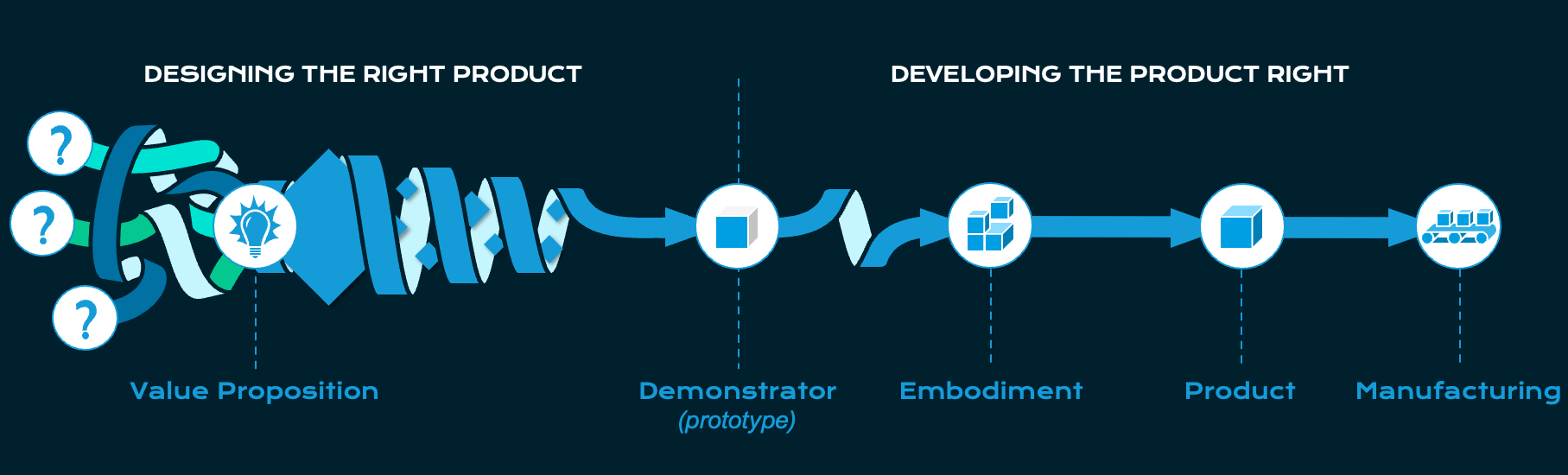
Our integrated development process
Good ideas are everywhere. Success depends on designing the right product from the start and developing it in a way that is reliable, manufacturable and scalable. We work as one integrated team with a lean development process, enabling us to learn faster, identify risks early and make well informed decisions. This reduces late design changes, prevents costly iterations and creates a smoother, more predictable transition to production.
Common mistakes when designing for plastics manufacturing
Several design flaws keep recurring. Uneven wall thicknesses cause uneven cooling, which can lead to warping or sink marks on the surface. Undercuts, where part of the component blocks the mold during ejection, make the mold unnecessarily complex and expensive. Overly tight tolerances demand more precise molds and stricter process control, driving up costs without always being functionally necessary. Identifying these pitfalls early saves considerable time and money in the later stages of the process. For companies that want to oversee the complete journey from idea to product, the roadmap for product innovation in SMEs is a logical next step.
From Prototype to Small-Series Production
What is the difference between prototyping and series plastic production? A prototype is used to test and validate a design. Series production focuses on repeatable quality at a low cost per unit. Between these two phases often lies a critical intermediate step.
The Importance of Prototyping Before Scaling
Before investing in a production mold, it is wise to first develop a prototype. This lets you validate that the design performs functionally, that the form is ergonomically sound, and that the product aligns with market needs. Issues uncovered at this stage are far less costly to resolve than those that only become apparent after the mold has been built.
Small-scale production as the bridge to high-volume manufacturing
After a successful prototype, moving straight into large-scale production is not always the wisest decision. Small-scale production provides a valuable intermediate step: manufacturing a limited series to further validate both design and market. This reduces risk and the required capital investment—particularly critical for SMEs. At PEZY, we guide companies daily from an initial sketch through to a series-produced plastic component, including material selection and mold construction. This phased approach gives a business the opportunity to refine and adjust before committing to large-scale investment.
Costs and Lead Times in Plastics Manufacturing
What does plastics manufacturing cost, and how long does a project take? Exact pricing is difficult to provide, as it varies significantly from one project to the next. The factors that drive both cost and lead time, however, can be clearly defined.
Which factors determine the cost price
The unit cost of plastics manufacturing is driven primarily by the mold, material selection, production volume, and design complexity. A complex mold featuring fine details or moving components requires greater investment to develop than a straightforward design. Material choice matters too: engineering-grade plastics generally command a higher price than standard resins. As volumes increase, the fixed costs of the mold are spread across more parts—driving down the cost per unit.
How to realistically estimate lead times
Lead times are frequently underestimated by companies without production experience. Developing a mold, validating an initial pilot run, and ramping up production all take time—particularly when interim adjustments are required. Those who factor this in only late in the process risk discovering that a launch date is no longer achievable. Engage a production partner early in the development process so that costs and lead times can be estimated realistically before expectations are set with customers or investors.

Case: Philips OneUp
When developing a new generation of floor cleaners, Philips had a clear ambition: an electric mop that cleans faster and is easier to use than existing solutions.
In practice, the challenge proved to be greater. Traditional mops use a bucket and reuse the same water, which can cause dirt to spread across the floor. Electric floor cleaners partially solve this problem, but they are often large, heavy and difficult to manoeuvre.
Outsourcing Plastics Production: Key Considerations
What to look for when outsourcing plastics production? Choosing the right partner largely determines whether a project runs smoothly—or stalls due to miscommunication and delays.
Criteria for Selecting a Production Partner
When selecting a production partner, prioritize technical expertise across manufacturing processes, proven experience in material selection, and flexibility in production volumes. A partner with a track record developing comparable products identifies risks earlier and provides more realistic guidance on feasibility, costs, and lead times. Also verify their experience in both prototyping and series production—so you avoid switching partners midway through the project.
Why a full-service partner saves time and reduces risk
A full-service partner that unites design, engineering and production reduces time and risk compared with separate suppliers for every phase. You work with one point of contact who oversees the entire trajectory—from first sketch through to series production of the plastic component. This eliminates misalignments between design and manufacturing and ensures design-for-manufacturing principles are applied from the outset rather than corrected afterwards.
Have a product idea that calls for plastics manufacturing? Get in touch with PEZY for a no-obligation discussion on how to take your concept from idea to series production—as part of a broader product innovation trajectory.
Ready to talk?
We work with companies that want to successfully develop products or components. Together, we achieve the best results, from initial concept through to production.

 PEZY is officially certified as a Great Place To Work™. This recognition is based entirely on feedback from our employees.