
Why plastic components are becoming increasingly intelligent
When companies consider smart products, their attention often focuses on the sensor, the chip or the connectivity being added. This is understandable: electronics are tangible and are often the first topic of discussion. As a result, the point where those electronics meet the plastic surrounding them is often overlooked.
Reading time: 8 minutes

- Plastic components do not become ‘smart’ simply by adding separate electronic components to them, but by designing their functions from the outset as a single product architecture.
- Techniques such as In-Mould Electronics make it possible to integrate sensors, antennas and lighting behind a closed surface.
- Fewer separate components does not mean less complexity: geometry and choice of materials directly determine the performance of the electronics.
- Only by bringing disciplines together at an early stage and validating them step by step can a smart product also become reliable and manufacturable.
For a long time, a plastic component was primarily seen as the outer shell of a product. It gave it shape, protected the technology and played a major role in determining its appearance. The ‘intelligence’ lay elsewhere: on a printed circuit board, in software or in a separate sensor.
That distinction is gradually disappearing. Sensors, antennas, lighting, touch controls and conductive connections are being positioned closer to the plastic or even integrated into the component itself. As a result, plastic is transforming from a passive housing into a functional part of the overall system.
This development makes products more compact, more user-friendly and better connected. At the same time, it calls for a different approach to development. Mechanics, plastics technology, electronics and software can no longer be designed in succession. From the outset, they must be approached as a single product architecture.
From housing to functional component
In many products, plastic forms the main interface between the user and the technology. It is the surface that a person sees, holds and operates. At the same time, it is situated directly around sensors, electronics, light sources and antennas. As a result, the plastic component has an ever-increasing influence on the product’s functionality.
Material properties play a key role in this. Plastics offer great design freedom and are generally lightweight and electrically insulating. Depending on the chosen material, wall thickness, colourants and any coatings, they can also transmit light or radio signals. This makes it possible to incorporate functions behind a closed surface, without visible buttons, openings or separate components.
Manufacturing techniques are also evolving in this direction. In In-Mould Electronics, for example, conductive structures and electronic functions are applied to a film and then incorporated into a plastic component. The research organisation VTT now has production lines for plastic integrated and structural electronics. A recent scientific review describes this technology as a route towards lightweight, form-fitting and multifunctional plastic components.
Electronics integration is changing product architecture
In a traditional product design, the various functions are brought together as separate components. A plastic housing, printed circuit board, buttons, cables, light guides, seals and fasteners together form the end product. Each component adds material, tolerances, assembly operations and potential points of failure.
By integrating functions more intelligently, this architecture can be simplified. For example, a plastic surface can simultaneously fulfil a structural function, act as a user interface and provide lighting. An antenna can become part of the three-dimensional shape. A sensor can be positioned closer to the point where measurements actually need to be taken. In some applications, cables, plugs and separate supports can be eliminated.
This can lead to fewer components, a smaller installation space, lower weight and less assembly work. It also creates new possibilities for the design and operation of products. Lighting and touch functions no longer need to be placed on the product as separate elements, but can become part of the surface itself.
However, the right solution is not always maximum integration. Sometimes, a separate and replaceable electronic module remains the better choice from a technical, economic or circular perspective. The key, therefore, is not how much electronics can fit into the plastic, but which product architecture offers the best balance between functionality, reliability, manufacturability, maintainability and cost.
A smart product is more than just a product with a sensor
Simply adding a sensor does not automatically make a product ‘smart’. For that to happen, the data measured must be converted into a relevant action, feedback or decision. A product only becomes truly intelligent when sensing, processing and responding are logically linked.
For example, a medical device can record whether it is being used correctly. A consumer product can measure how often it is used and indicate when maintenance or refilling is required. An industrial component can monitor temperature, pressure or vibrations and issue a warning if performance deviates from the norm. In all these cases, the value is not created by the sensor itself, but by what the product does with the information.
According to NIST, an IoT product consists of more than just the physical device. Network connections, applications, gateways and back-end systems can also form part of the product. This makes it clear why smart product development does not stop at simply fitting electronics into a casing.
The IoT extends the product’s lifespan beyond the point of sale
Connecting a product to the internet creates a continuous flow of information between the physical product and the digital environment. Sensor data can be monitored remotely, analysed and used to trigger an action. The European Commission cites monitoring, insights and responses from other connected devices, amongst other things, as key applications of the IoT.
This also changes the relationship between the manufacturer and the product. Whereas a traditional product largely disappears from view after delivery, a connected product can continue to provide information throughout its entire lifespan. This offers opportunities for condition-based maintenance, better support, software improvements and new services. Usage data can also provide valuable input for the next generation of products.
These opportunities also entail responsibilities. Decisions must be made regarding what data is collected, where it is processed, how long software is supported and how updates are carried out securely. The European Cyber Resilience Act therefore sets out cybersecurity requirements for the planning, design, development and maintenance of products with digital elements. Smart products thus require not only product development, but also ownership of the digital lifecycle.
Fewer components do not automatically mean less complexity
Functional integration can simplify the final product assembly, but introduces new dependencies during development. The performance of electronic components is directly influenced by the geometry, choice of material and manufacturing method of the plastic component.
A sensor must not only fit, but also be able to take measurements in the correct position and under the right conditions. An antenna must take into account surrounding materials, metal parts and the user’s position. Electronics generate heat, whilst the housing often also needs to keep out dust and moisture. Conductive inks, films, adhesives and components must be resistant to deformation, injection pressure, temperature fluctuations and long-term use.
The scientific literature on In-Mould Electronics therefore identifies material compatibility, deformation, adhesion, process errors, reliability, quality assurance and industrial scalability, amongst other things, as key areas of concern. The intelligence of the product thus places higher demands on interdisciplinary collaboration.
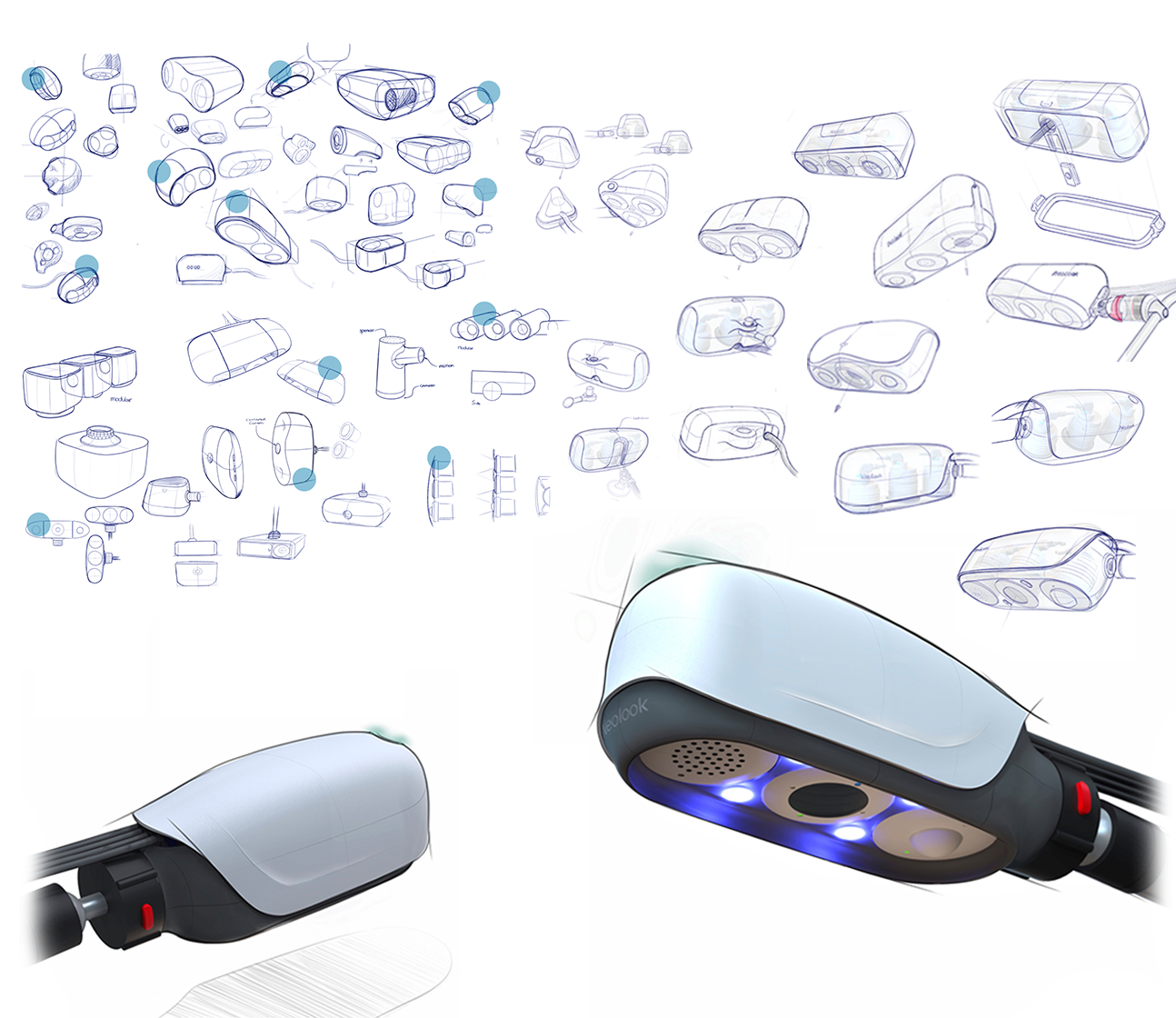
Case: Neolook One
When developing a new monitoring system for the NICU and PICU, Neolook had a clear ambition: an integrated hardware product that combines camera images and sensor data, bringing care for newborns closer to the patient.
However, hospitals impose strict requirements on medical equipment, and a system that allows hardware and software to work together seamlessly did not yet exist. There was a lack of a solution that was both technically robust and practical for everyday clinical practice.
Intelligence begins with plastic architecture
In a sequential development process, the electronics are often designed first, followed by the creation of a plastic housing into which everything must fit. This can work for simple products. However, as soon as sensors, antennas, lighting, controls and connectivity become part of the user experience, there is almost always interaction between the disciplines.
The position of a sensor influences the shape of the component. The space required for the antenna influences the internal layout. The light distribution places demands on the material, surface finish and wall thickness. Heat generation influences ventilation, construction and sealing. Assembly, testability and maintenance must also be taken into account in these decisions.
That is why the key system questions must be answered at an early stage. What information does the product need to collect? Which function delivers demonstrable value to the user? Where should sensors and actuators be located? How will the electronics be powered and connected? Which components must remain replaceable? And how will the entire system be reliably manufactured and tested?
By addressing these questions at an early stage, the plastic component can be developed around the desired functionality from the outset. This prevents the need for electronics, design and production to be adapted to one another at a later stage.
Early prototypes must validate the entire system
With smart products, a prototype of the housing alone is insufficient. A design model can reveal a great deal about ergonomics and appearance, but very little about signal quality, thermal management, light distribution, sealing or the reliability of the integrated electronics.
Validation must therefore be built up step by step. First, the technical operation of individual functions is examined. Next, the critical interfaces between plastic, electronics and software are tested. It must then be demonstrated that the chosen materials and production techniques can consistently deliver the same performance.
It is precisely in this final step that many risks become apparent. A design may function well in the laboratory, but still prove to be unstable during injection moulding, assembly or final testing. Early involvement of plastics engineering and industrialisation helps to make the transition from a working prototype to a reliable production product manageable.
Smarter design means integrated design
Plastic components are becoming increasingly intelligent as functions shift towards the product’s surface and structure. Mechanics, electronics, sensors and connectivity converge at the point where the product communicates with the user and their environment.
This development offers significant opportunities. Products can become more compact, lighter, more intuitive and better connected. At the same time, the boundaries between disciplines are blurring. A choice of material or geometry can have a direct impact on electronic performance, software functions, production and the digital lifecycle.
That is why PEZY brings together product design, plastics engineering, electronics integration, prototyping and industrialisation at an early stage. Not to cram as much technology as possible into a plastic component, but to translate the right functions into a reliable, manufacturable and scalable product.
The question, therefore, is not simply which smart functions can be added to a product. The more important question is how plastics, electronics and software can be designed as a single system from the outset.
Ready to talk?
We work with companies that want to successfully develop products or components. Together, we achieve the best results, from initial concept through to production.

 PEZY is officially certified as a Great Place To Work™. This recognition is based entirely on feedback from our employees.