Proof of Concept: validate technical feasibility early
A proof of concept (PoC) validates early in the development process the technical feasibility of a core function. The aim is a binary determination of whether a mechanism or principle physically works under controlled conditions, independent of aesthetics, user experience or market potential. A PoC prevents resources being spent on a design that is physically unrealizable.
In brief
- PoC versus prototype: a PoC tests pure function with raw, inexpensive materials and simple test rigs; a prototype addresses form, ergonomics and user experience — confusion between the two causes waste.
- Measurable success criteria and go/no-go moments: define quantitative thresholds in advance (e.g. force, temperature, accuracy), decide based on objective test data and record results thoroughly as the basis for next steps.
- Materials, manufacturability and scope: also validate production constraints early (material behaviour, mouldability, tolerances) and isolate critical technical risks in targeted tests; a positive PoC leads to detailed design and prototyping with attention to manufacturability.
A brilliant product idea remains a gamble until the technical foundations are unequivocally established. Many innovation trajectories fail not for lack of creativity or market potential, but because fundamental physical assumptions are only tested late in the process. A proof of concept forces you to surface that uncertainty early and validate it technically before you release budget for full development. It is the necessary brake on enthusiasm that prevents you investing in a product that cannot physically exist.
What is a proof of concept in product innovation?
Definition and purpose of a PoC
A proof of concept validates only the technical feasibility of a core functionality, independent of aesthetics, ergonomics or commercial market potential. The question is binary: can a specific mechanism or principle physically work under controlled conditions? You are not seeking a refined user experience here, but hard evidence that the underlying technology does what the theory promises.
This stage acts as a filter against unrealistic concepts and protects your organisation from costly mistakes in later phases.
When do you start a proof of concept?
You start a proof of concept as soon as an idea relies on a technical assumption that cannot be directly derived from existing knowledge or standards. Waiting until the design is largely finalised is a common mistake: a fundamental problem then only emerges after significant time and money have been spent on detailing. Teams that skip this validation step often encounter unforeseen physical limitations in practice that are extremely expensive to remedy afterwards.
For you as product lead this means you must temporarily park design and marketing until the technical side is proven.
The crucial difference between a proof of concept and a prototype
Difference in objective and scope
Confusion between these two terms practically leads to wasted time and resources: a proof of concept tests pure function with raw materials, whereas a prototype also addresses form, ergonomics and user experience. They are often used interchangeably, but serve entirely different purposes and require a different mindset from the development team. Understanding the difference with prototyping is essential to avoid investing too early in things that do not yet matter.
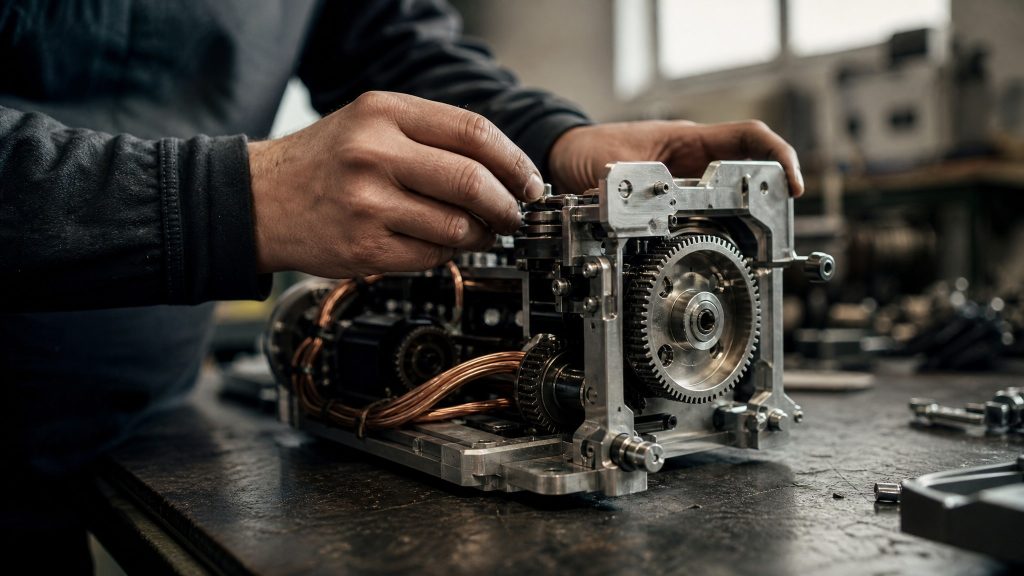
A PoC may look like a messy laboratory setup, as long as the technology demonstrably works according to the set criteria.
Material choice and level of finish
In a technical validation you choose inexpensive standard components and rapid manufacturing methods that only support functionality, without regard for the eventual production standard. Aesthetic finishing, colour choice and premium materials are in this phase pure distractions; they do not contribute to answering the core question. By strictly separating function validation and form validation you avoid budget evaporating on cosmetic improvements of a concept that may prove technically untenable.
The only property that matters is whether the system delivers the intended physical performance under test conditions.
The role within the development process
Experience shows that separating function validation (PoC) and form validation (prototype) prevents budget from being wasted on cosmetic improvements of a technically unsustainable concept, and stops projects from bogging down in endless iterations without a foundation. A proof of concept stands at the start of the funnel and determines whether the idea is viable at all. Only then is there room for further refinement towards a manufacturable product. Without this clear cut you risk developing a beautiful-looking model that can never be produced reliably on the factory floor.
Your task is to vigilantly maintain this distinction within your team and resist the temptation to try to solve everything at once.
Testing technical feasibility: the core of every PoC
Identifying critical technical risks
When testing technical feasibility it is all about isolating the greatest uncertainty, such as a specific hinge mechanism, complex thermal management or sensor integration under heavy load. You build targeted test rigs that stress only that one variable rather than emulate a complete system. This requires analytical rigour and the courage to ignore secondary functions. If the primary failure mode of your innovation is not fully understood, further refinement of peripheral matters is pointless and you waste valuable development time.
PEZY emphasises that “manufacturable innovation” requires technical feasibility to lead before aesthetic choices, with a PoC functioning as a filter against unrealistic concepts.
Test rigs for mechanics and electronics
Targeted test setups allow you to investigate specific variables in isolation, without the noise and complexity of an integral system design. Whether it concerns tensile strength, thermal conductivity or signal integrity: the setup must be as simple as possible so that measurements can be interpreted unambiguously. Complex simulations help predict behaviour, but physical tests remain necessary to confirm assumptions about material behaviour and tolerances.
You must be willing to build ugly, functional rigs that do nothing else but confirm or refute your core hypothesis.
Validation of material and production constraints
Technical feasibility includes not only the operating principle, but also whether the chosen materials and processes are suitable for the intended application. A mechanism may perform perfectly in the lab with machined aluminium, but prove impossible to injection-mould in the required plastic due to shrinkage or flow behaviour. This validation prevents a brilliant lab setup later failing because production constraints cannot be reconciled with the design.
Ignoring manufacturability at this early stage is a guarantee of costly disappointments during scale-up.
Formulating success criteria for an objective assessment
From vague idea to measurable specifications
Without predefined, quantitative criteria a proof of concept quickly becomes an endless search for perfection instead of a binary validation moment. Therefore define concrete thresholds, such as minimum force, maximum temperature or required accuracy, before the first screw is turned, and record them as hard requirements. This documentation later forms the backbone when you produce a product specification and protects against scope creep when enthusiasm overrides realism.
Success is not a feeling, but a measurable value that has been agreed in advance and can be objectively verified afterwards.
Defining go/no-go decision points
An effective validation trajectory has predefined moments at which you decide whether the technology is robust enough to proceed to the next phase. These go/no-go decisions must be based on the previously established measurements, not on hope or political pressure within the organisation. Having the courage to stop based on negative test results is as valuable as a positive outcome: it prevents committing good resources to a dead end.
Your responsibility is to treat these decision points as sacrosanct and not to shift them under the influence of optimism.
Documentation as the basis for next steps
Thorough recording of test results, deviations and lessons learned ensures that knowledge is retained for the follow-up process, even if the team composition changes. This data feeds into determining the Technology Readiness Level and guides the requirements for mass production and quality assurance. Without this documentation the PoC remains a standalone exercise whose insights do not become embedded in product development.
Do not see reporting as an administrative burden, but as the foundation for all future design decisions.
Practical examples of successful and failed PoC trajectories
Lessons from medical devices
In sectors such as healthtech regulation often determines the test criteria: a proof of concept must demonstrate that a mechanism fails safely before any user tests are considered. In medical product development the PoC often serves as the first validation of safety mechanisms according to MDR requirements, independent of the final design. Failing to meet these strict safety requirements in the concept phase is a hard stop, regardless of how promising the clinical application may otherwise appear.
Regulatory compliance here is not an afterthought but the starting point for every technical validation.
Challenges in consumer electronics
With consumer products we more often see that integrating compact electronics into a tight housing becomes the bottleneck, requiring early thermal simulations alongside physical tests. The available space for cooling and antenna placement frequently conflicts with aesthetic wishes, making technical compromises inevitable to achieve a working whole. A PoC that looks only at electronic functionality but ignores thermal management produces a product that becomes unreliable in practice due to overheating.
You must accept that the physics of heat dissipation sometimes outweigh the desired industrial design.
Patterns in industrial innovation
Industrial applications often require validation under extreme environmental conditions such as dust, vibration or chemical exposure, which are difficult to simulate in a sterile lab environment. These examples show that the nature of the product determines which question must be answered first, and that generic checklists rarely suffice for complex innovations. Copying a validation approach from another sector regularly leads to false security, because failure mechanisms in heavy industry are fundamentally different from those in consumer goods.
Tailoring the test approach is not a luxury, but a necessity for reliable results.
From proof to manufacturable innovation: the next steps
A positive proof of concept is not an automatic green light for mass production, but the signal to proceed to detailed design and prototyping with attention to manufacturability. Here the focus shifts from “can it work” to “can we make it reliably and cost-effectively”, which requires different expertise and a different set of validation criteria. Linking PoC results to Design for Manufacturing principles prevents a brilliant lab setup from failing on the factory floor because it is not producible.
This article covers the technical validation phase and does not provide a solution for products whose market demand or business case is still unclear; other instruments are needed for that.
If you doubt whether your innovation is technically feasible, or you are stuck in the translation to manufacturability, a Break-through Session will help you sharpen the critical uncertainties and draft a targeted validation plan.
From insight to results